
Astronomy in Waldorf Education
By Laura Rubiano-Gomez and Liz Castaldi
In the spring of 2026, Gathering Waters high school students completed an Astronomy elective class, pulling the complexities of space exploration and observational science into real world focus. Anchored by a presentation from retired NASA Mission Control Chief Training Officer Cassandra Rodriquez and a large-scale community observational SkyWatch event, the course connected classroom study directly with professional aerospace operations and the night sky.
In Waldorf education, classes are designed to meet students where they are developmentally, growing in depth and complexity as the students mature. Astronomy offers an example of this scaffolding and progression, bridging scientific observation with the developmental journey of the human being, first in sixth grade, and revisited in high school.
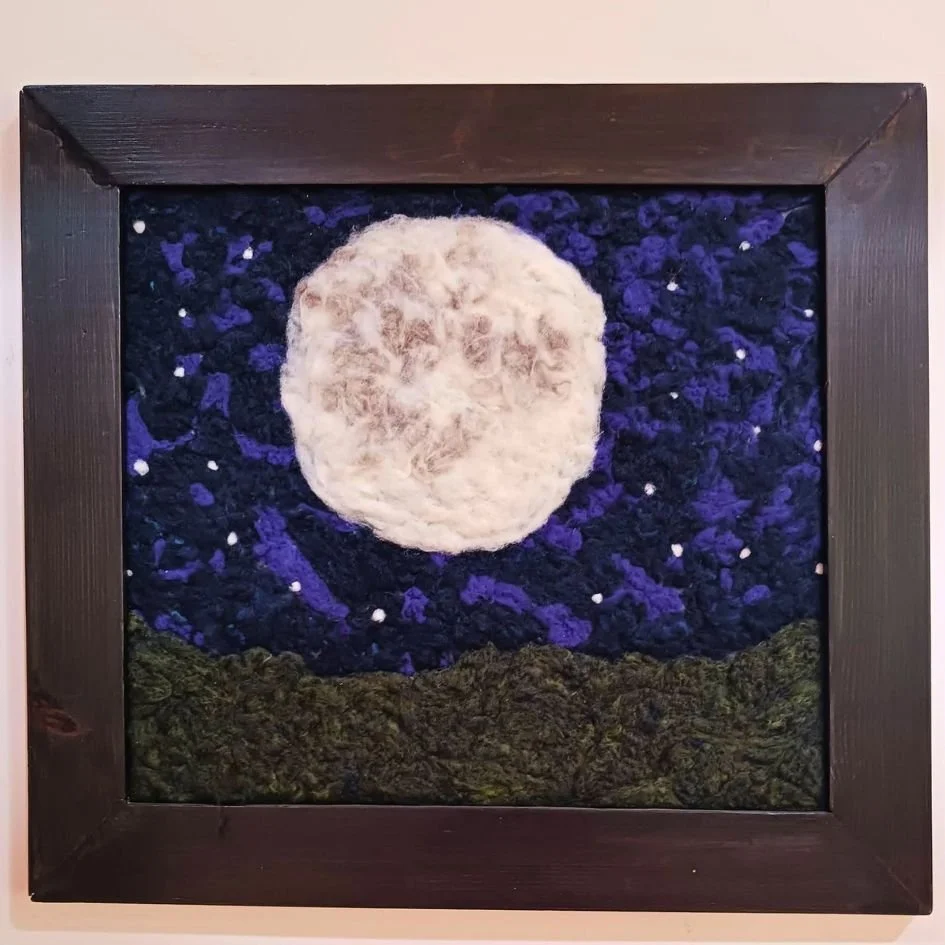
Gathering Waters student art on display in collaboration with The Sustainability Project, at the Emerson Brook Forest Center in Gilsum, NH.
Following the Stars Through the Grades
The path of astronomy in the Waldorf curriculum mirrors the inner development of the student, moving from the tangible and Earth-centered to the abstract and cosmic.
Sixth Grade: Looking to the Heavens While Grounded on Earth
In the sixth grade, astronomy is introduced observationally, forming a natural counterpoint to the geology block. Students begin their study of the Earth and then look outward into the sky.
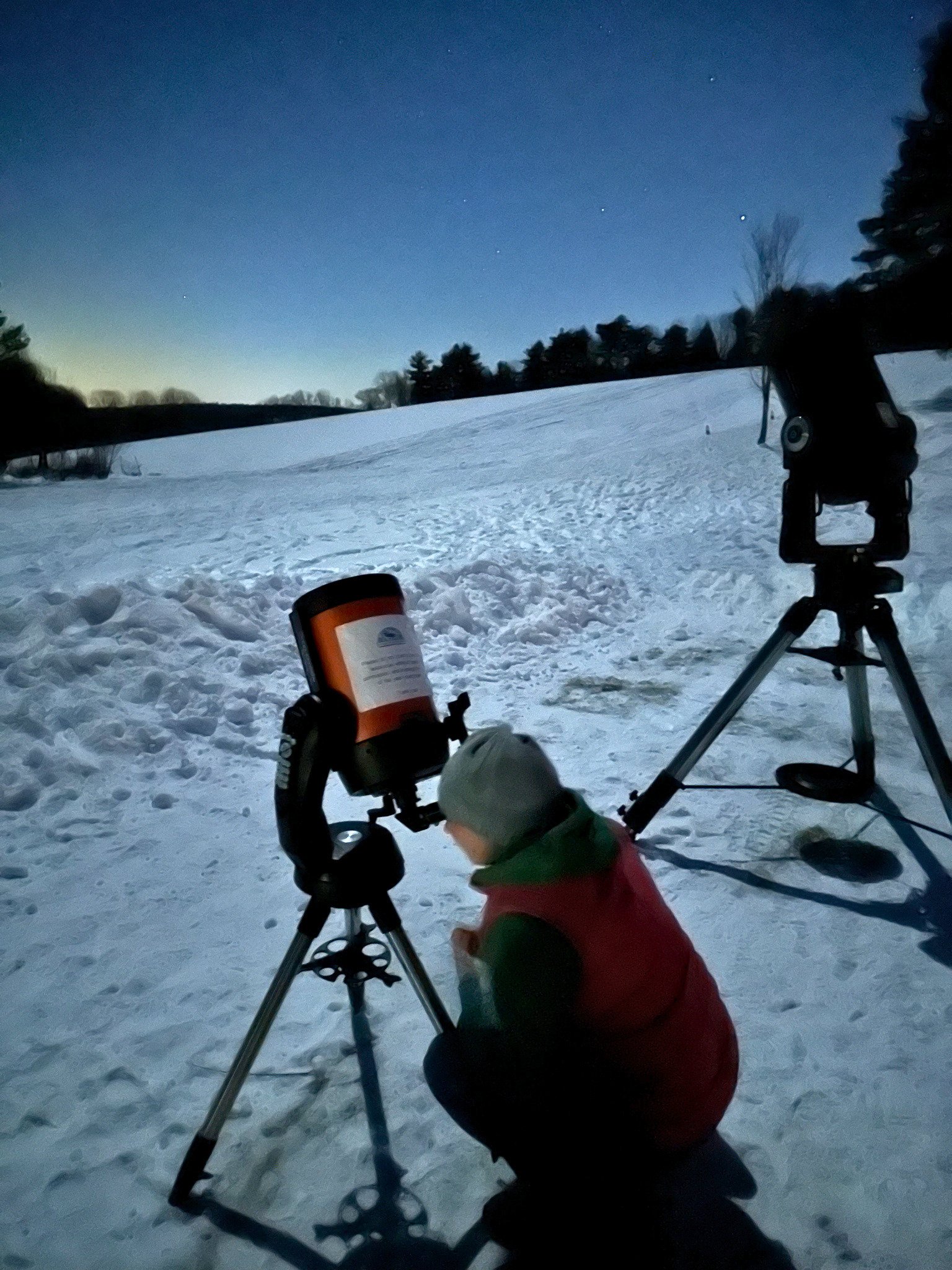
Gathering Waters student observing the night sky at Camp Glen Brook in Marlborough, NH.
This scientific journey parallels their cultural studies of Rome, the Islamic world, and the Middle Ages, as each of these cultures were deeply connected to celestial observations.
The curriculum follows the progression from the earthly materialism of the Roman era, through the cosmic observation of Islamic scholars, toward the striving virtues of the medieval world, culminating in the traditional knighting ceremony.
High School Astronomy: Expanding Horizons
In high school astronomy, studies move to develop abstract models to explain student observations, in order to understand the intricate motions involved. An important aspect of the class is the ability to understand how motions would differ if one’s point of view changes. How would we experience the movement of the sun if we were stranded on planet Uranus? What would we experience on a daily and yearly basis?
The broader high school curriculum eventually confronts the deep philosophical questions of our place in the universe, human hubris and egotism, and the realization we are not the center of the universe.
In history class, this coincides with a deep dive into the Middle Ages, while mathematically, students engage with projective geometry and the concept of the infinite.
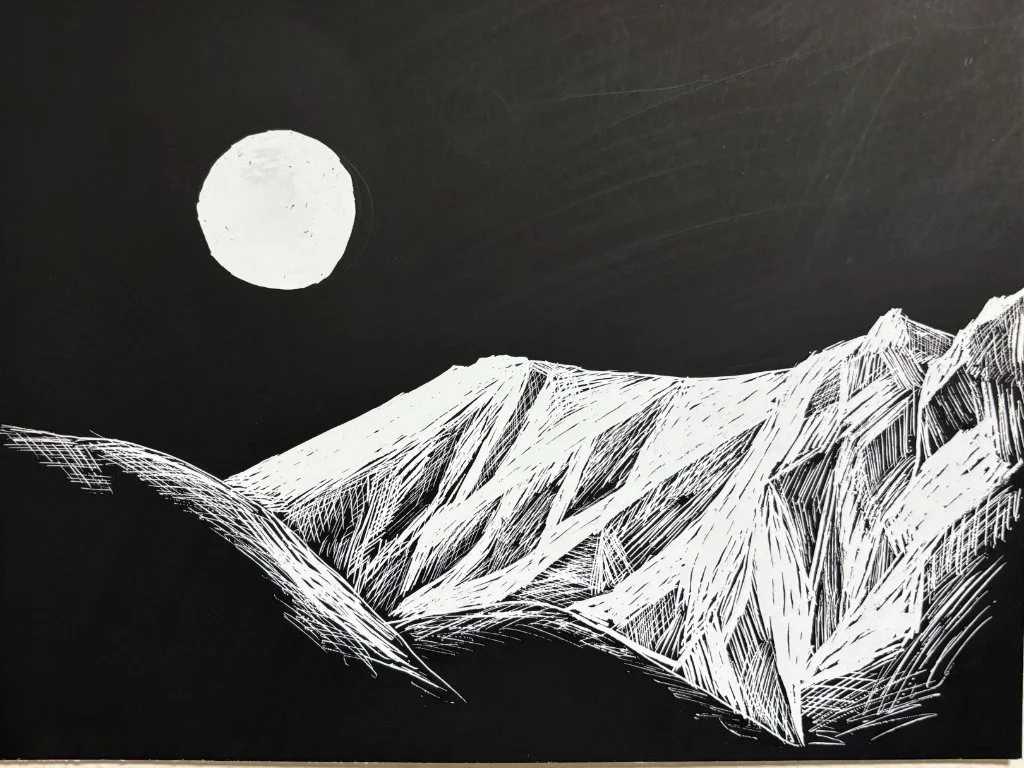
Gathering Waters student artwork.
Astronomy Elective: Putting Theory into Practice
The 2026 astronomy elective class combined these themes and provided a comprehensive look at both the history and the future of space exploration.
NASA Veteran Visit & Artemis II
Before the world was abuzz with news surrounding the Artemis II mission, before the terms “Mission Control, LOS, and CAPCOM” entered our daily lexicon, the class was visited by retired NASA Mission Control Chief Training Officer Cassandra Rodriquez.
As part of the NASA Mission Control team, Ms. Rodriquez planned, trained and executed over 54 International Space Station (ISS) Expeditions and 21 Shuttle Missions. She trained astronauts to safely operate and live on the ISS, and was also the voice of Mission Control to the crew onboard ISS as a Capsule Communicator (CAPCOM).
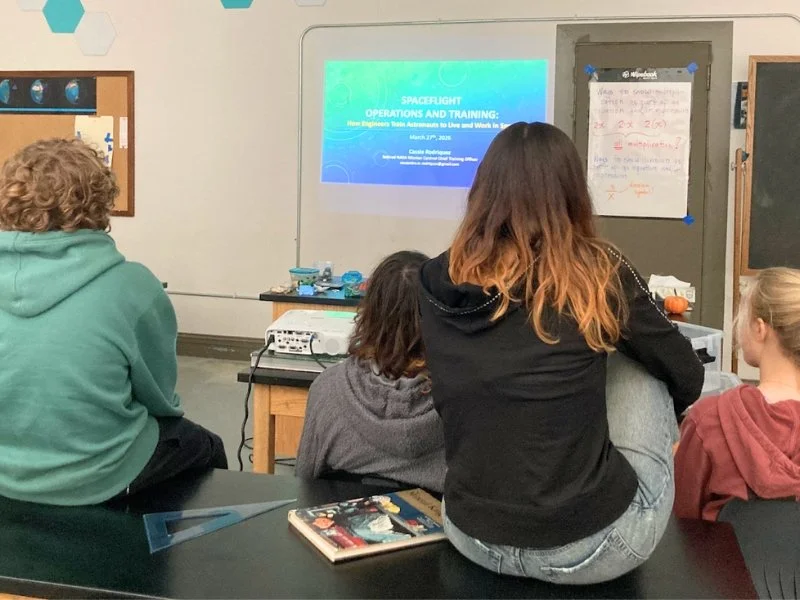
Astronomy students (grades 11 and 12) watching the presentation on Spaceflight Operations and Training by retired NASA Mission Control Chief Training Officer, Cassandra Rodriquez.
During Ms. Rodriquez’s presentation, Astronomy students had the opportunity to learn about the systems and purpose of the International Space Station (ISS), the extent of human body research that takes place on the ISS, how astronauts train to live and work in space, and the systems needed to keep them alive and happy, including working toilets.
Throughout the course, students also followed the progress of the Artemis II mission as it reached the farthest distance humans have ever traveled from Earth—a mere 252,756 miles. This global milestone provided a contemporary backdrop to the students' studies.
To ground these concepts in direct experience, Gathering Waters hosted a community SkyWatch.
Community SkyWatch
Hosted by Gathering Waters, students ranging from elementary through high school, parents, and community members gathered at Kroka Expeditions to hear a presentation from representatives from the New Hampshire Astronomical Society. They also had the opportunity to hold a piece of an iron meteorite that is estimated to be about 4.5 billion years old (likely formed as part of the development of the Solar System) from the Campo del Cielo crater in Argentina.

Gathering Waters Astronomy student holding a remnant of a meteorite estimated to be 4.5 billion years old — the oldest thing he is likely to hold in his lifetime.
This was followed by an evening of guided star gazing (with and without telescopes) where they viewed Jupiter and its four largest moons, Venus, the Orion Nebula, as well as globular star clusters.
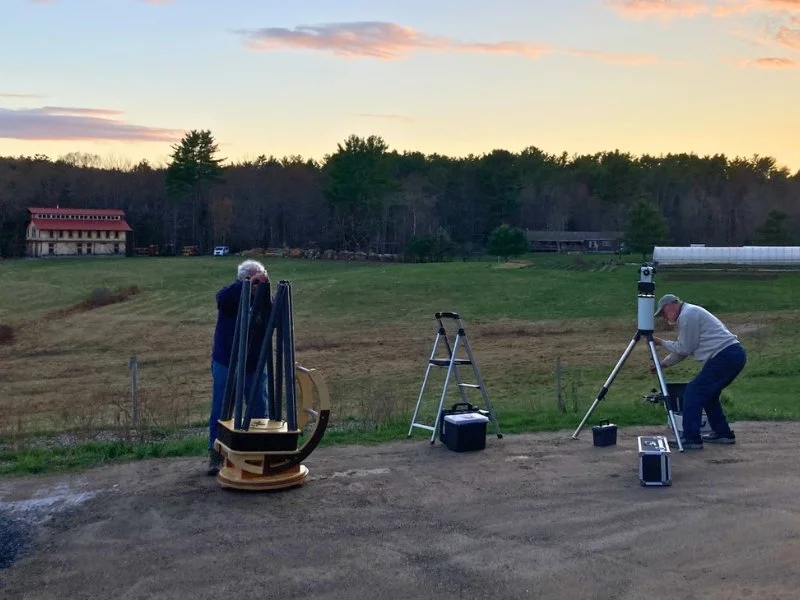
Members from the New Hampshire Astronomical Society setting up their telescopes in preparation for the SkyWatch.
Thank you to Steve, Mark, and Joe from the NH Astro for your guidance during the SkyWatch, and a special thank you to Kroka Expeditions for partnering with us to hold this special event.
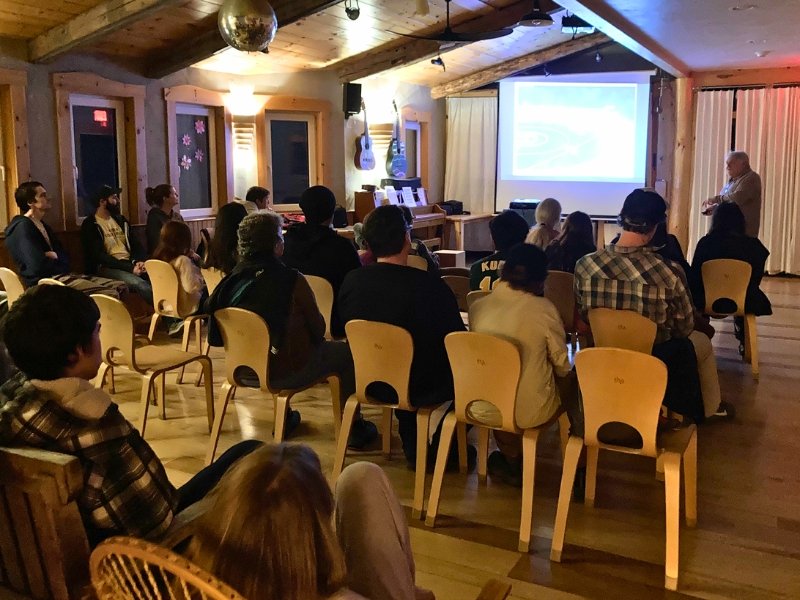
Gathering Waters students, elementary school through high school, listening to Steve Rand’s overview of our place in the universe.
A Wider Lens
By combining veteran expertise with local astronomical resources and community partners, the 2026 astronomy course captured an essence of Waldorf education: connecting academic rigor with genuine human experience, awakening a sense of awe in our students and our community.
Whether a sixth grader is observing the night sky with intention, or a high schooler is working with the concept of infinity, astronomy at Gathering Waters invites students to look outward with clarity and wonder.